Global trade
Global trade growth continues, but rising fragility weighs on developing economies
Despite robust global trade growth in 2025, rising geopolitical tensions and disruptions to key shipping routes are increasing risks across the global economy, with implications for developing economies.

The April edition of the UN Trade and Development Global Trade Update finds that, while global trade in goods and services grew by $2.5 trillion in 2025 to reach $35 trillion, the outlook is becoming increasingly uncertain.
The ongoing conflict in the Middle East and the shipping disruptions in the Strait of Hormuz are disrupting energy flows and shipping routes, raising trade costs and adding pressure on countries with limited fiscal space.
For many developing economies, these disruptions translate into higher import bills, tighter financial conditions and reduced capacity to sustain growth and development, although some emerging economies continue to show resilient demand and support global trade flows.
Trade growth remains strong but uneven
Global trade growth remained strong into early 2026, with continued expansion in both goods and services, although services growth has slowed in recent quarters and part of the increase reflects higher prices rather than volumes.
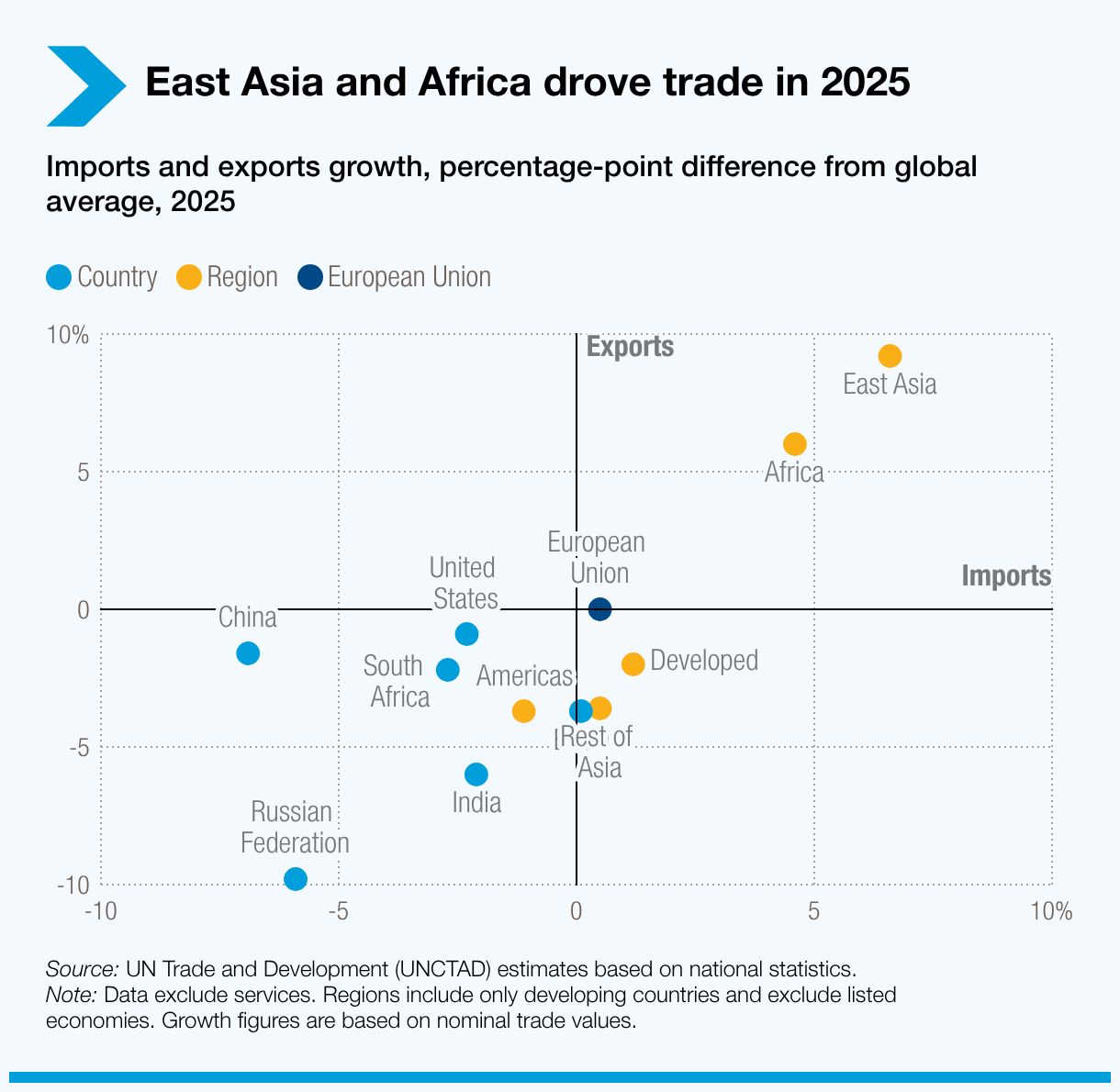
Much of this growth has been driven by developing regions, particularly in East Asia and Africa, as well as strong South–South trade.
This reflects the increasing role of developing economies as engines of global trade. However, uneven participation means that many countries still struggle to fully benefit from these gains.
East Asia and Africa drove trade in 2025
Imports and exports growth, percentage-point difference from global average, 2025
-10-50510%-10-50510%BrazilBrazilChinaChinaDevelopedDevelopedAfricaAfricaAmericasAmericasEast AsiaEast AsiaRest ofAsiaRest of AsiaEuropean UnionEuropean UnionIndiaIndiaRussian FederationRussian FederationUnited StatesUnited StatesSouth AfricaSouth Africa
Imports
Exports
Source: UN Trade and Development (UNCTAD) estimates based on national statistics.
Note: Data exclude services. Regions include only developing countries and exclude listed economies. Growth figures are based on nominal trade values.
New trade patterns reshape opportunities
Amid ongoing United States–China trade decoupling, new “connector economies” are emerging, helping sustain global trade flows despite rising fragmentation.
For some developing countries, this shift is creating new opportunities to attract investment and integrate into global value chains. These dynamics reflect a reconfiguration of trade flows, with some countries increasing trade with both major economies.
‘Connector economies’ emerge as US-China trade declines
Trade growth with the United States and China, per cent, 2025 vs 2024
Connector economies
Trade growth with China
Trade growth with the US
Source: UN Trade and Development (UNCTAD) estimates based on national statistics.
Note: Growth figures are based on nominal trade values.
Manufacturing drives growth, but vulnerabilities persist
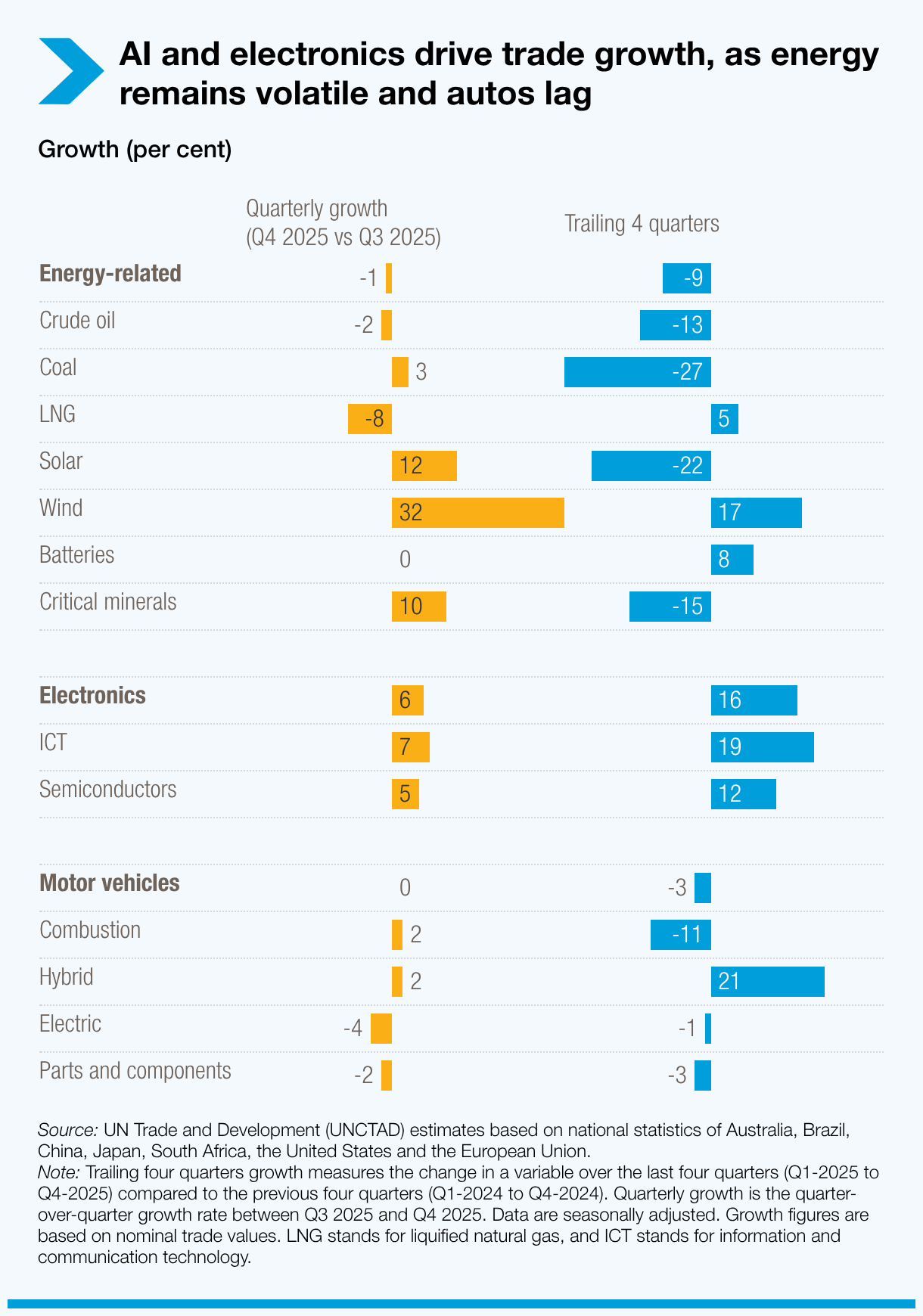
A strong manufacturing sector, particularly in electronics and technology-related goods, has been a key driver of global trade growth.
Yet other sectors, including automotive trade, remain subdued amid rising protectionism. For developing economies seeking to diversify and move up value chains, these divergent sectoral trends highlight both opportunities and constraints.
AI and electronics drive trade growth, as energy remains volatile and autos lag
Source: UN Trade and Development (UNCTAD) estimates based on national statistics of Australia, Brazil, China, Japan, South Africa, the United States and the European Union.
Note: Trailing four quarters growth measures the change in a variable over the last four quarters (Q1-2025 to Q4-2025) compared to the previous four quarters (Q1-2024 to Q4-2024). Quarterly growth is the quarter-over-quarter growth rate between Q3 2025 and Q4 2025. Data are seasonally adjusted. Growth figures are based on nominal trade values. LNG stands for liquified natural gas, and ICT stands for information and communication technology.
Slower growth expected ahead
Despite recent gains, global trade growth is expected to slow in 2026 due to persistent geopolitical uncertainty, inflationary pressures and rising trade costs.
For developing countries, the combination of higher energy prices, increasing debt pressures and more restrictive trade policies risks constraining investment, weakening demand and limiting development prospects.
Keeping trade working for development
The report highlights the importance of maintaining open and predictable trade conditions amid rising uncertainty.
Strengthening cooperation, reducing fragmentation and ensuring that developing countries can participate fully in evolving trade patterns will be important for supporting inclusive and sustainable development outcomes.