UN Trade and Development
Services growth puts policy and data at the centre of diversification push
17April2026
UN Trade and Development advances agenda on diversification as global trade shifts toward services.

Services are rapidly reshaping global trade – and the pace of change is accelerating. For many developing economies, the challenge is no longer whether services matter, but whether policy frameworks are keeping up.
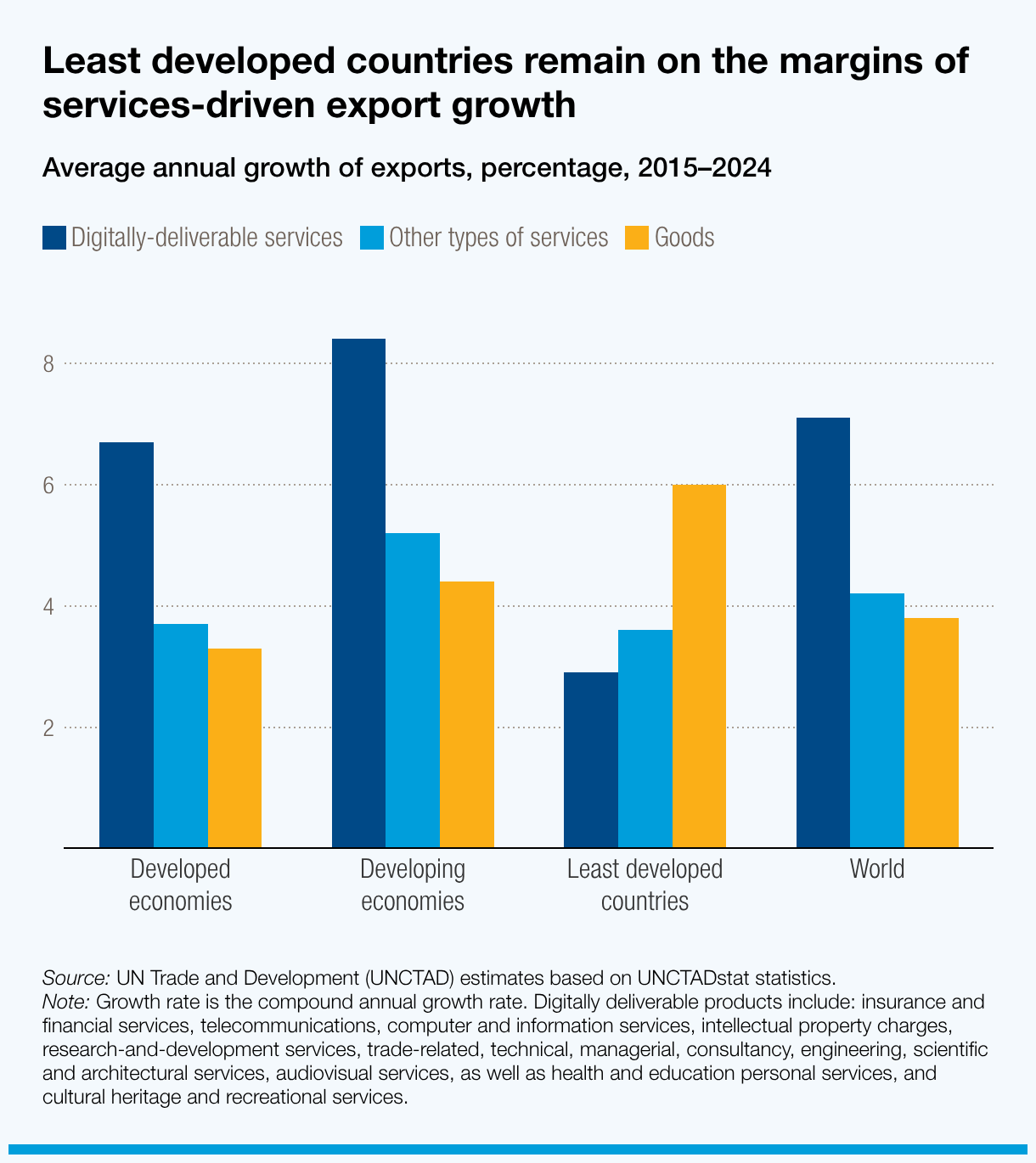
Global trade in services has grown by around 5.3% annually over the past decade – faster than goods trade – and now accounts for more than a quarter of total trade. This expansion is driven by digitally deliverable services, including IT, finance and professional services, enabled by rapid digitalization.
Yet participation remains highly uneven. Developed economies dominate exports of digitally deliverable services, while many developing and least developed countries remain on the margins. As services become central to value creation, this gap risks widening without targeted policy action.
Bridging it requires more than expanding trade. It depends on whether countries can design trade and regulatory frameworks that support domestic capacity to produce, export and benefit from services.
Least developed countries remain on the margins of services-driven export growth
Average annual growth of exports, percentage, 2015–2024
Source: UN Trade and Development (UNCTAD) estimates based on UNCTADstat statistics.
Note: Growth rate is the compound annual growth rate. Digitally deliverable products include: insurance and financial services, telecommunications, computer and information services, intellectual property charges, research-and-development services, trade-related, technical, managerial, consultancy, engineering, scientific and architectural services, audiovisual services, as well as health and education personal services, and cultural heritage and recreational services.
Servicification reshapes production and trade
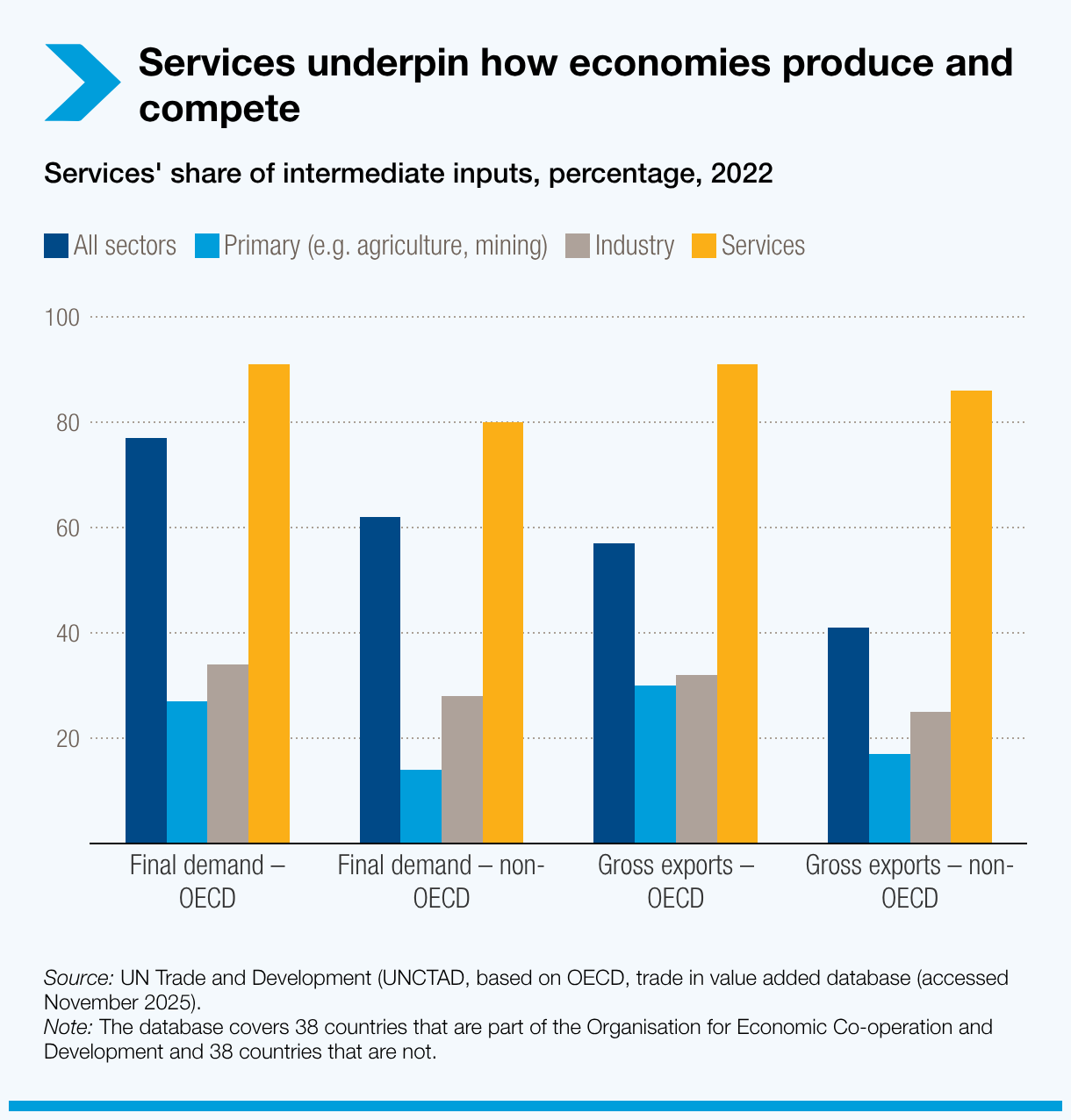
At the heart of this shift is “servicification” – the growing integration of services across all stages of production. From logistics and finance to digital design and marketing, services are now embedded across sectors, shaping how economies compete and diversify.
For developing economies, this creates new pathways for structural transformation. But outcomes hinge on infrastructure, skills and regulatory environments that support services-intensive production.
Services underpin how economies produce and compete
Services’ share of intermediate inputs, percentage, 2022
Source: UN Trade and Development (UNCTAD, based on OECD, trade in value added database (accessed November 2025).
Note: The database covers 38 countries that are part of the Organisation for Economic Co-operation and Development and 38 countries that are not.
Trade policy is becoming a central lever. Recent negotiations increasingly include provisions on digital trade – such as cross-border data flows, data protection, electronic transactions and digital infrastructure – now critical to how services are supplied and traded.
These provisions can reduce regulatory fragmentation and improve predictability, enabling firms to access services inputs across borders. At the same time, restrictive measures risk limiting access to key services and constraining participation in global value chains.
Data gaps limit policy effectiveness
Despite the growing importance of services, policymaking remains constrained by limited data, particularly in developing countries.
Gaps in detailed statistics on services trade – across sectors, partners and modes of supply – make it difficult to identify competitive strengths, assess barriers and negotiate effectively. Strengthening data systems is therefore both a technical and policy priority.
From global dialogue to practical solutions
Against this backdrop, UN Trade and Development (UNCTAD) convened the 12th session of its multi-year expert meeting on trade, services and development on 15-16 April in Geneva, focusing on servicification and its implications for diversification.
As UNCTAD’s flagship forum on services, it brought together policymakers and experts to exchange country experiences and practical approaches. Discussions underscored how policy frameworks, regulatory choices and trade agreements shape outcomes – and the need to better align data, policy and implementation.
Supporting countries to move from data to impact
UNCTAD is complementing dialogue with targeted analytical and capacity-building support. Its Primer on data for trade in services and development policies, alongside related webinars, has reached nearly 700 participants.
Work with CARICOM is helping countries strengthen both the production and use of services trade data through the Trade-in-Services Information System (TiSSTAT). Recent workshops in Dominica and Grenada brought together over 60 participants from more than 35 institutions, with nearly 90% reporting improved ability to use services data in policy work.
Further sessions are planned in Saint Lucia and Saint Kitts and Nevis.
Scaling impact through partnerships
With demand for support growing, UNCTAD is advancing plans for a knowledge-sharing hub to connect policymakers, statisticians and experts and promote the use of services data in policymaking.
The objective is to strengthen the link between evidence and action – helping countries translate services trade growth into gains in diversification, resilience and long-term development.